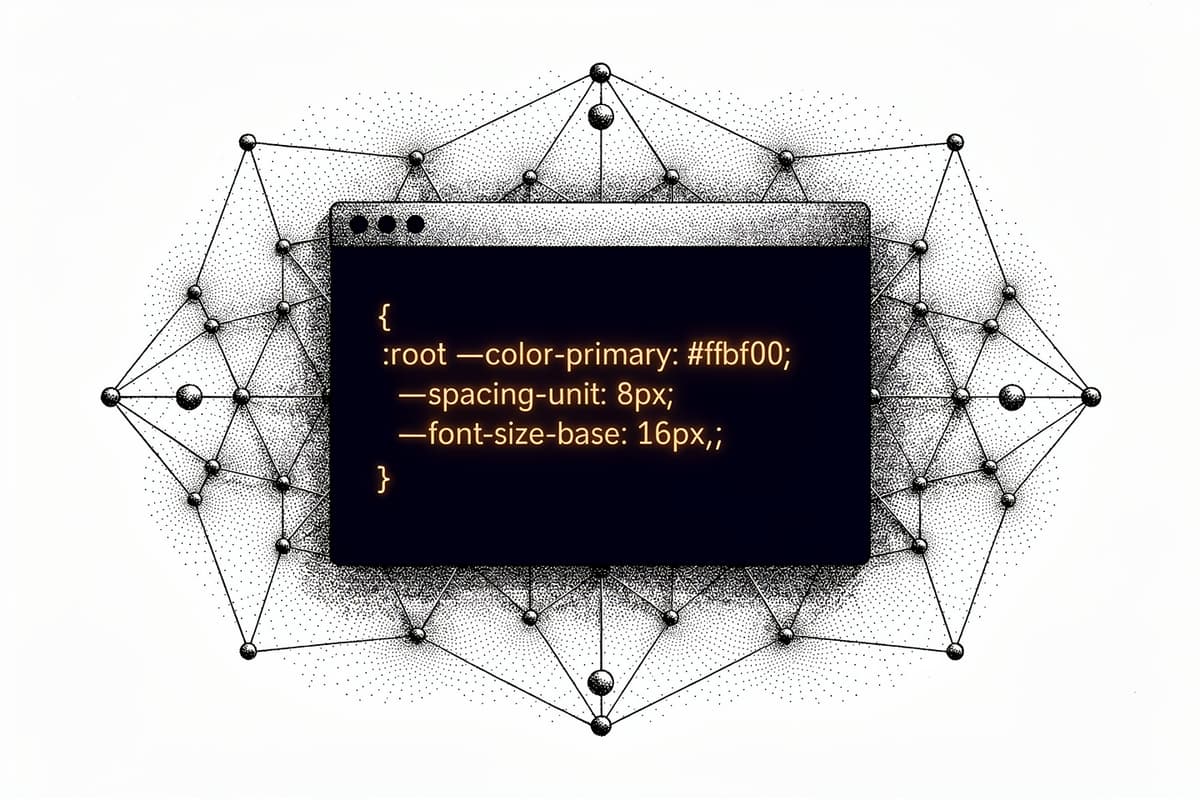
@jh3yy — CSS custom properties as animation levers
Lean into CSS custom properties 🤙
.char {
  filter: blur(calc(1rem * var(--blur, 1)));
  transition: filter var(--speed, 5s);
}

.char:hover {
  --blur: 0;
  --speed: 0.1s;
}
That's a genuinely tidy pattern. Instead of duplicating filter values, you expose two levers — --blur controls magnitude, --speed controls direction of the transition asymmetry. Hover in snaps instantly, hover out eases slowly, and it's all controlled from one set of custom properties. The calc(1rem * var(--blur, 1)) default means the element starts blurred with zero extra markup.

Lean into CSS custom properties 🤙 .char { filter: blur(calc(1rem * var(--blur, 1))); transition: filter var(--speed, 5s); } .char:hover { --blur: 0; --speed: 0.1s; }
@jameswlepage — Mixtral 22b running locally on M1 via Ollama
Running Mixtral 22b on a M1 Mac is pretty wild @ollama
Local inference on consumer hardware keeps getting more accessible. ollama handles the model download and quantization so you don't have to think about GGUF files or llama.cpp flags — just ollama run mixtral. 22b parameters on an M1 is legitimately surprising; a year ago that would've required a server with serious VRAM.

Running Mixtral 22b on a M1 Mac is pretty wild @ollama

@LangChain — RAG from Scratch, free on freeCodeCamp
RAG From Scratch on FreeCodeCamp
We recently released a playlist of videos that explain RAG fundamentals and highlights over a dozen advanced RAG papers / methods.
This tutorial is now free on @freeCodeCamp!
Thanks @beaucarnes and team.
Honestly a good resource. The playlist covers not just naive RAG but a dozen advanced methods from actual papers — query transformation, re-ranking, HyDE, RAPTOR. If you're building retrieval pipelines and haven't read the papers, this is a faster path to the concepts than hunting down each one on arXiv.

RAG From Scratch on FreeCodeCamp We recently released a playlist of videos that explain RAG fundamentals and highlights over a dozen advanced RAG papers / methods. This tutorial is now free on @freeCodeCamp! Thanks @beaucarnes and team. Video: youtube.com/watch?v=sVcwVQ… Show more

@pontusab — all transactions stored as vectors via Supabase embeddings
Milestone 🫶
And thanks to @supabase AI embeddings we have all transactions stored in vector 🔥 - blog post coming soon!
Interesting milestone for Midday (Pontus's open-source finance platform). Using Supabase's pgvector integration to embed financial transactions means you can run semantic queries over spending history without a separate vector DB. The fact that it's all in Postgres keeps the stack simple. Waiting for the blog post to see what the embedding model and query patterns actually look like.


Milestone 🫶 And thanks to @supabase AI embeddings we have all transactions stored in vector 🔥 - blog post coming soon!

@dsiroker — Limitless: personalized AI backed by a wearable recorder
Introducing Limitless: a personalized AI powered by what you've seen, said, or heard.
It's a web app, Mac app, Windows app, and a wearable.
This is the relaunch of Rewind with a wearable pendant added to the mix. The premise is a local model that has full context of your life — meetings, conversations, documents — and answers questions across that. The privacy architecture (they call it Confidential Cloud) is doing real work here: if people don't trust what gets recorded and where it goes, nothing else matters. I'll believe the "your data stays yours" story when someone audits the binary. Still, the idea of a personal AI that actually has context about your work is the right problem to be solving.

Introducing Limitless: a personalized AI powered by what you’ve seen, said, or heard. It’s a web app, Mac app, Windows app, and a wearable. 0:06 Reveal 0:48 Why Limitless? 1:39 Demo 3:05 Pendant 4:27 Privacy 5:23 Confidential Cloud 6:36 Rewind 7:12 Roadmap 9:25 Vision
@dillon_mulroy — fix key repeat in Vim on macOS
Vim and Neovim users on OSX, set this in Keyboard settings and thank me later
If you've ever held down j in Normal mode and watched the cursor crawl because macOS intercepts key repeats for its accent picker — this is the fix. System Settings → Keyboard → Key Repeat Rate + Delay Until Repeat. Crank both. The accent popover goes away when you disable press-and-hold per-app (defaults write com.apple.Terminal ApplePressAndHoldEnabled -bool false), but the repeat speed is a separate setting most people never touch. Small thing, big daily difference.


Vim and Neovim users on OSX, set this in Keyboard settings and thank me later
